Home
Search:
English | Français | Ελληνικά
Home

Events

There are no upcoming events at this time. Please check back later.

CIG on FacebookOur blog

Latest News

The Leukos Survey Project 2011

2011.12.05 12:25 Harbours of Leukos and Sokastro

A team from the Canadian Institute conducted its third and final survey season at Kato Leukos, Karpathos, this summer. The project is co directed by Ian Begg (Trent University) and Michael Nelson (Queen’s College, New York). Todd Brenningmeyer (Maryvale College, St. Louis) was responsible for the geophysical survey, and Amanda Kelly (National University of Ireland, Galway) for the ceramics. The survey also benefited greatly from the various rescue digs conducted by the Greek Archaeological Service at Kato Leukos, whose data they have shared with us.

The results of our survey are still preliminary, pending a study season. In brief, though, the beaches at Kato Leukos once served as harbours in the Early Byzantine period, with evidence for a seaside bathing establishment as well as small scale industrial activities. There were at least two paleo-Christian basilicas, one now along the water-line because of local subsidence of the land. On top of the offshore islet of Sokastro, a fortification wall protected an elaborate complex of many barrel-vaulted cisterns and at least one church; the date for construction is not yet ascertained but the sherd cover dates to the 11th, mostly 12th, and 13th centuries. It will take some time to analyze the field data, including over 2,000 aerial images of Sokastro alone.

A Cistern on Sokastro

After a final study season, the future of Canadian research activity at Leukos is not certain, although not for any lack of potential. Years ago the Greek Archaeological Service had the foresight to acquire a large tract of land along the shore to protect it from development and so it shelters an undisturbed Early Byzantine harbour town. In contrast to ancient written sources, there is recent and accumulating archaeological evidence throughout the Dodecanese for widespread prosperity in the Late Antique/Early Byzantine period, primarily dozens of paleo-Christian basilicas, and Kato Leukos offers a window into the secular and naval life on which that prosperity was based; we do know that around 410 a Karpathian fleet regularly brought grain from Alexandria to Constantinople. Finally, the uniquely preserved complex of cisterns on top of Sokastro may well exemplify a naval base where ships of someone’s fleet could be resupplied with water, etc., and so determining who built it and when would have obvious ramifications for our meagre knowledge of the naval history of the Aegean in the Middle Byzantine period, when Crusaders from the West were encountering Arabs from the East.

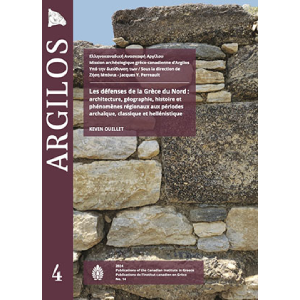
Campagne d’étude 2011 à Argilos

Pendant 4 semaines, du 20 juin au 16 juillet, près d’une trentaine d’étudiants ont participé à la campagne d’étude d’Argilos. Encadrés par des archéologues, dessinateurs et...

Read more

Excavations at Ancient Eleon 2011

This significant site in eastern Boeotia (central Greece), located near the modern village of Arma, approximately 50 kilometers north of Athens and 14 kilometers east of Thebes, is identified as...

Read more

Khostia Archive and Boeotian Studies

John Fossey, Emeritus Professor of Classical Studies at McGill University, and currently Curator of Archaeology at the Montreal Museum of Fine Arts, was recently in Athens and donated to us the...

Read more